When Will Luck Be Healthy Again
One of the greatest computer programmers of all fourth dimension grew up almost Seattle. He saw an upstart visitor, Intel, making computers on a chip and was among the start people to run across the potential of these then-called microcomputers. He dedicated himself to writing software for the new device and, by i account, "wrote the software that ready off the personal computer revolution."
In the mid 1970s, he founded a company to sell software for micro-computers. In the early history of the company, "the atmosphere was zany," and "people came to work barefoot, in shorts," and "anyone in a suit was a company." Simply the company was soon highly profitable, and by 1981 its operating system had a dominant share of the market for personal computers that used Intel microprocessors.
For all of its early triumphs, the company's watershed moment came when IBM visited in the summertime of 1980 to discuss an operating system for its new PC. After some negotiation, the 2 companies struck a deal. In August 1981, retailers offered the company's software aslope the brand new IBM PC, and the company'southward fate was sealed. The rest is history, as they say.
In instance this story's not familiar, hither's the ending. This pioneer of computer engineering entered a biker bar in Monterey, California, on July 8, 1994, wearing motorbike leathers and Harley-Davidson patches. What happened next is unclear, but he suffered a traumatic blow to the caput from either a fight or a autumn. He left under his own power simply died three days afterwards from the injury, complicated past his chronic alcoholism. He was fifty-two years sometime. He is buried in Seattle and has an etching of a floppy disk on his tombstone. His proper name is Gary Kildall.
You'd be excused for thinking that the start role of the story is about Bill Gates, the multibillionaire founder of Microsoft. And information technology is certainly tantalizing to ask whether Gary Kildall could have been Pecker Gates, who at 1 betoken was the earth'due south richest man. But the fact is that Bill Gates fabricated acute decisions that positioned Microsoft to prevail over Kildall's visitor, Digital Research, at crucial moments in the development of the PC manufacture.
When IBM executives first approached Microsoft most supplying an operating system for the company's new PC, Gates really referred them to Digital Research. There are conflicting accounts of what happened at the meeting, but it's fairly clear that Kildall didn't run into the significance of the IBM bargain in the way that Gates did.
IBM struck a bargain with Gates for a lookalike of Kildall's product, CP/M-86, that Gates had acquired. Once information technology was tweaked for the IBM PC, Microsoft renamed it PC-DOS and shipped information technology. Afterward some wrangling by Kildall, IBM did concur to ship CP/Grand-86 as an alternative operating system. IBM too fix the prices for the products. No operating system was included with the IBM PC, and everyone who bought a PC had to purchase an operating organization. PC-DOS cost $40. CP/One thousand-86 cost $240. Guess which won.
But IBM wasn't the direct source of Microsoft's fortune. Gates did cut a deal with IBM. Only he also kept the right to license PC-DOS to other companies. When the market for IBM PC clones took off, Microsoft rocketed away from the competition and ultimately enjoyed a huge competitive advantage.
When asked how much of his success he would attribute to luck, Gates allowed that information technology played "an immense function." In detail, Microsoft was launched at an ideal fourth dimension: "Our timing in setting up the start software company aimed at personal computers was essential to our success," he noted. "The timing wasn't entirely luck, just without neat luck it wouldn't have happened."
Making Your Own Luck
Since luck is intimately intertwined in all of our lives, it comes as no surprise that there are plenty of aphorisms that address luck:
- "You make your own luck."
- "Luck is what happens when grooming meets opportunity."
- "I'm a great believer in luck, and I discover the harder I work, the more than I accept of it."
Grooming and hard work are essential elements of skill. They oft lead to skillful outcomes. Merely the aphorisms don't actually accost what's happening. If you prepare and work hard, yous are successful not because your luck improves. Luck doesn't change at all. Only your skill improves. And you can work hard and prepare and build the best American diner on Route 66 just when the Interstate highway bypasses your town and puts you out of a chore.
There's another popular statement that says you tin can't get lucky unless you arrive luck's style. For case, you can't win the lottery unless you play. On one level, of form, this is true. But information technology glosses over two important points. Luck can be good or bad. While winning the lottery does seem similar good luck, it's hard to say that losing the lottery is bad luck. Losing the lottery is expected. Lotteries are designed to take in more than money than they dole out, so they are a loser's game in the amass. The main issue is that putting yourself in a position to enjoy skilful luck too puts yous in a position to lose.
The other indicate is that the very endeavour that leads to luck is a skill. Say that you need to complete x interviews with prospective employers to receive one job offer. Individuals who seek only v interviews may non get an offer, but those who go through all ten interviews volition take an offer in hand past the end of the process. Getting an offering isn't luck, information technology'southward a matter of effort. Patience, persistence, and resilience are all elements of skill.
The all-time-known advocate for the idea that you can create your own luck is Richard Wiseman, a professor at the Academy of Hertfordshire who holds United kingdom of great britain and northern ireland'due south Chair in the Public Understanding of Psychology. Wiseman's investigations are offbeat and fun. For case, he conducted a "scientific search" for the world's funniest joke. (The winner: Two hunters are out in the woods when 1 of them collapses. He doesn't seem to exist breathing and his eyes are glazed. The other guy whips out his phone and calls the emergency services. He gasps, "My friend is dead! What tin I do?" The operator says, "Calm downwardly. I tin assistance. First, let's make sure he's dead." There is a silence, then a shot is heard. Back on the phone, the guy says, "OK, now what?") He also argues that he has found "a scientifically proven way to understand, control, and increment your luck."
Wiseman nerveless a sample of hundreds of individuals and had them rate themselves on their beliefs about luck. He and so sought to explain "the different means in which lucky and unlucky people thought and behaved" and identified the "iv principles of luck." The principles include maximizing your chance opportunities, listening to your lucky hunches, expecting good fortune, and turning bad luck into good. Wiseman'south research is unfailingly lively and provocative and he comes across as an energetic and intellectually curious human being. Unfortunately, expert scientific discipline this is not.
In one experiment, Wiseman asked people playing the U.K. National Lottery to submit a form that included information on how many tickets they intended to buy and whether they considered themselves lucky. Of the seven hundred–plus respondents, 34 pct considered themselves lucky, 26 percent unlucky, and forty percent were neutral. 30-vi of the respondents (virtually 5 pct) won money that night, carve up evenly between the lucky and unlucky people. Individuals lost £2.50 on average, just every bit you would await co-ordinate to the number of tickets purchased. Wiseman points out that this experiment shows that lucky people aren't psychic (just in case you lot thought they were); he likewise rules out any human relationship between intelligence and luck.
Suffice information technology to say that there is no manner to better your luck, because anything you exercise to improve a issue can reasonably exist considered skill.
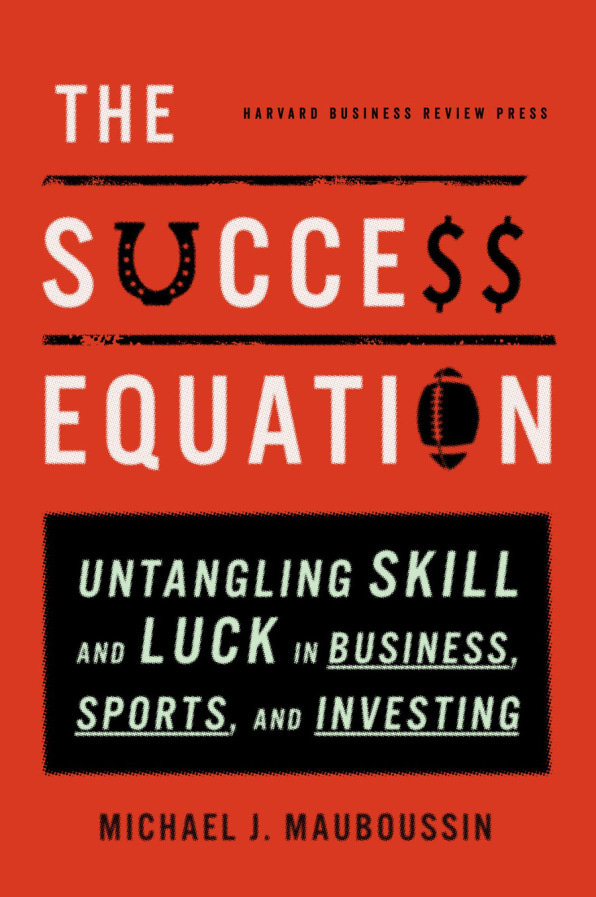
Reprinted by permission of Harvard Business organisation Review Press. Excerpted from The Success Equation: Untangling Skill and Luck in Concern, Sports, and Investing. Copyright 2012 Michael J. Mauboussin. All rights reserved.
Michael J. Mauboussin is an investment strategist and has been in the financial services manufacture for more than twenty-5 years. He has as well taught at the Columbia Graduate School of Business since 1993, and is on the board of trustees at the Santa Iron Institute. He is the writer of two previous books, "Call up Twice: Harnessing the Ability of Counterintuition and More Than Yous Know: Finding Fiscal Wisdom in anarchistic Places" and is coauthor, with Alfred Rappaport, of "Expectations Investing: Reading Stock Prices for Better Returns."
[Epitome: Flickr user Bill S]
Source: https://www.fastcompany.com/3002729/facts-luck

Enregistrer un commentaire for "When Will Luck Be Healthy Again"