Drawing of a Perfect Circle
Despite the mythical prowess of Leonardo da Vinci, most of us mere mortals can't describe a mathematically perfect circle by hand – merely it's possible to do with GIMP, even if you lot tin can't draw at all with a pencil.
Now before you outset getting derisive, I'thou going to just openly admit that *I* am ane of those people who can't draw by hand at all. I've come up to the graphics world through photography and design rather than the more traditional fine arts, so please forgive my complete lack of drawing skills 😉
GIMP doesn't have something as uncomplicated equally a Circle tool similar you can detect in Inkscape or Illustrator, simply that doesn't mean you've got to channel the legendary (and probably apocryphal) skill of a Renaissance man just to draw a mathematically perfect circle.
Quick Navigation
- Ii Quick Methods to Depict a Circle in GIMP
- 1. The Paintbrush Method
- 2. The Ellipse Select Method
- What About The Paths Tool?
- A Last Word
Two Quick Methods to Depict a Circle in GIMP
Here are the 2 fastest and simplest methods to draw a circle in GIMP:
1. The Paintbrush Method
Stride i: Select the Paintbrush tool from the toolbox, or use the shortcut P.
Pace ii: In the Tool Options console, gear up the Size choice to whatever size you desire your circumvolve to be, and then set the Hardness option to 100.
Footstep three: Click once anywhere on your image to draw your perfect circle.
2. The Ellipse Select Method
Step 1: Switch to the Ellipse Select tool from the toolbox, or use the shortcut Due east.
Step 2: Hold down the Shift primal to lock the selection into a circle, and click and drag to create your circular selection.
Step 3: Switch to the Bucket Fill tool using the toolbox or use the shortcut Shift + B, and click anywhere inside your option to fill it with the currently-selected foreground color.
I can't choose which of these two methods is easier, and then it's upward to y'all to choose which one fits best with your personal style and workflow.
The Paintbrush method might exist slightly faster, but the Ellipse Select method gives you a lot of extra flexibility – and y'all tin reposition it if you don't identify it perfectly right away.
What Most The Paths Tool?
In a couple of the other drawing tutorial posts, I've recommended using the Paths tool to create reusable stencils for your drawings. You tin definitely practice the same affair for drawing circles, but it'southward not near every bit effective because ensuring that your path is actually a perfect circumvolve tin quickly become a tedious and time-consuming process.
Instead of wasting your time fiddling effectually with Bezier curve handles, you can use a modified version of the Ellipse Select method to create a reusable path for you! This option is definitely the most time-consuming, only it besides gives you a perfectly circular stencil you can use for a range of purposes.
Follow the first two steps as described to a higher place to create a perfectly circular selection, simply when you get to Step 3, practice not use the Bucket Fill tool. Instead, wait for the Paths panel, usually located in the bottom right corner of the GIMP interface.
It's located in a tabbed window within the Layers console, simply if it'southward non visible yous tin bring the Layers panel back using the shortcut Ctrl + L. You can also recover the panel by opening the Windows menu, selecting Dockable Dialogs, and clicking Layers.
Forth the lesser of the Paths panel, detect the button labeled Selection to path (see the highlighted button in a higher place). This volition convert your selection into a set of Bezier curves automatically, without y'all having to fiddle around trying to go all the handles positioned properly
Optionally, you can concord downward the Shift key while you click Selection to path to get access to some advanced settings that command how GIMP creates your new paths, but as you lot tin see below, they're not kidding when they say 'advanced'. For our purposes, the default settings are fine.

GIMP will calculate the shape of your choice and describe a path, which appears as a new entry in the Paths console named Selection by default, but you lot can rename it to something easier to think similar Circle Stencil.
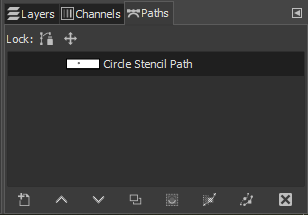
Cancel the Ellipse Select marquee by pressing Ctrl + Shift + A (Command + Shift + A on a Mac), or open the Select menu and cull Select None. You can so switch to the Paths tool using the toolbox or by pressing the shortcut B to see how GIMP has constructed it.

With the Paths tool agile, select your path in the Paths console and hold downwardly the Alt key (use the Option cardinal on macOS) to move it effectually your epitome as needed.
Once you're happy with its location, information technology'southward time to apply a stroke or fill to the path to create your actual circle. In the Tool Options panel, you'll see that the Paths tool has a few actress features that brand this longer procedure worth information technology for the extra flexibility.

If yous want to fill your circle completely, choose the Fill Path option. GIMP volition prove yous a simple dialog box that lets yous cull between filling your circle with the currently selected foreground colour or the currently selected blueprint in the Patterns panel (located in a tabbed dock next to the Brushes console).
If yous'd rather take an outlined circumvolve, choose the Stroke Path option. This has a few more options than the Fill Path route, simply that extra flexibility lets you set all the characteristics of your line, even creating your outline with a blueprint.
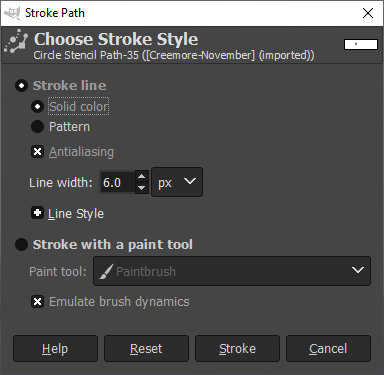
But well-nigh importantly, you can as well set up the stroke to employ whatever of GIMP'south brush tools from the trusty paintbrush to the Dodge/Burn tool used for local contrast adjustments. This lets you create perfect circles that look paw-painted thank you to the castor effects – and in one case yous've got the stencil set upwardly the first fourth dimension, information technology's to move them around and reuse them!
A Terminal Word
I often say that there are many means to achieve the same issue in the world of digital graphics, but few examples showcase the fact more effectively than something bones like drawing a circle in GIMP. It would be overnice if there was a unproblematic Circumvolve tool, simply yous'll take to look to a program similar Inkscape if you want things to be that great and piece of cake.
Do you have a favorite method for drawing circles in GIMP that I've left out of this guide? Let me know in the comments and I'll accept a look!

Source: https://thegimptutorials.com/how-to-draw-circle/

Enregistrer un commentaire for "Drawing of a Perfect Circle"